The State of Gaming on MacOS (2023)

The TEXT in this article is home-grown, cage-free and removed from any preservatives. In other words, no AI parser has touched these words. The use of technology was done "manually" - meaning I googled my sources, read articles, watched videos, and got my hands dirty with the tool before putting hand to keyboard. However, the images featured in this article were solely sourced from MidJourney AI.
Please mind that I will take some liberties here in respecting my target audience - I will run this post with the assumption that you have an enthusiasts-level knowledge about PC gaming tech (such as VRR tech, GPU names, vendors, etc). I will do my best to announce when I'm purposely glossing over info.
Note: For statistics collection where I couldn't gather them from Statisca or Steam Charts, I leveraged the collection efforts on Wikipedia.
One last note: I am using a MacBook Pro 2019 16inch 2021 M1 Pro, with 16GB of RAM. This is the middle of the line SOC, when compared to that years lineup of M1 > M1 Pro > M1 Max > and M1 Ultra. In comparison to known GPUs, we're talking about a GTX 1050 or GTX1050Ti ballpark. Not absurdly impressive, but when you consider the fact that's it's an SOC - well that changes the picture. A 1050 or 1050Ti should be perfectly capable of 1080p gaming on last gen PS4/Xbox-One titles, as well as older PC games, and even newer AAA titles with a much more humble settings match - not to mention emulation.

MacOS
...many words come to mind when thinking of Apple computers. Artistic might be the first one. Sleek. Prestiege. Intentional. When a user thinks about getting a Mac, odds are they made that decisions years ago when they walked by and saw someone sitting on a college campus library or a cafe in the middle of the city with the iconic bitten apple emblazed along the reflective silver of a MacBook Pro.
Popular among developers, beat makers, graphic designers, artists, video editors > all these users have one thing in common: they are creatives. And I might be wrong here, but creatives might want to try out a video or two on their time off.
That got me to asking some questions. What is the history of MacOS in gaming? Did it ever have one? What is the state of MacOS gaming now? What's the community think of MacOS teasing a gaze at the PC gaming market? How has the SteamDeck, along with Proton, affected this market? Is this just a pipe dream?
I'm hoping the summaries below will get us a little closer to the whole picture.
Why am I writing about this?
Well, I suppose it occurred because I found someone. ❤️ And so... I'm not at home as much as I used to be. This means that with the exception of my phone, my laptop is the device I have on me the most ~ and it's one hell of a product. The other purpose comes from an innate desire to utilize this piece of hardware to the fullest extent. I am a little bored ~ I know you can spend money and buy the latest AMD and NVIDIA parts, or even go middle of the road, and get what you need to have a decent PC gaming experience. Honestly, the PC space is pretty much figured out at this point ~ I say this at the expense of being wrong in the coming months, when a sudden change in temperature changes the PC landscape... but that's how I feel. Now, a MacBook with apple silicon... now that's uncharted territory. There are possibilities there left unexplored, and it excites me.

Who's got a Mac anyway?
More than you'd think ~ with an install base that surpasses the Switch, XboxOne, and PS4 markets combined (if you want to be cheeky with the data that is).
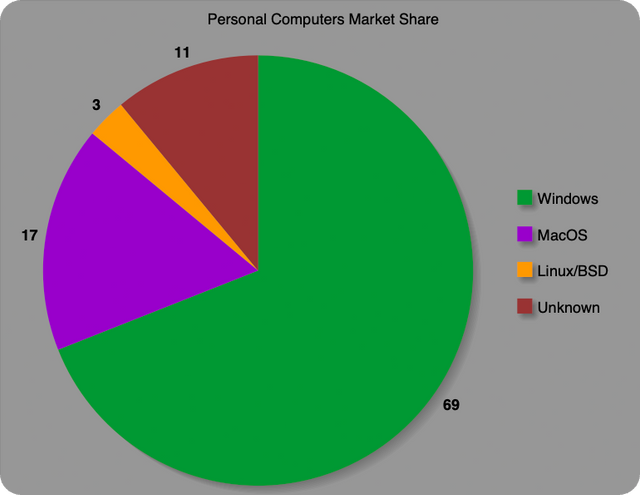
Global Personal Computer Market Share
- As of April 2023, the estimate of the market share for desktop/laptop computers on MacOS sits at 17%.
- Compare this with Windows, siting at 69% (lol) and "desktop Linux" sitting at 2.9% - with "unknown" OS's left to obscure forms of Linux or BSD - this math still leaves us with 11% unknown adoptions of OS's across the population (tracking this stuff is hard).
- Let's keep playing with estimates here - and the estimate right now is that about 2 billion personal computers (this includes desktops and laptops) are out there in the world.
- At 17%, that's 340,000,000m MacOS devices just waiting to be gamed on.
Steam Survey Results and what it tells us
- Note: Steam monthly active users is estmated to be at 120 million users since 2020 (my gut tells me that number has gone up several million since the pandemic).
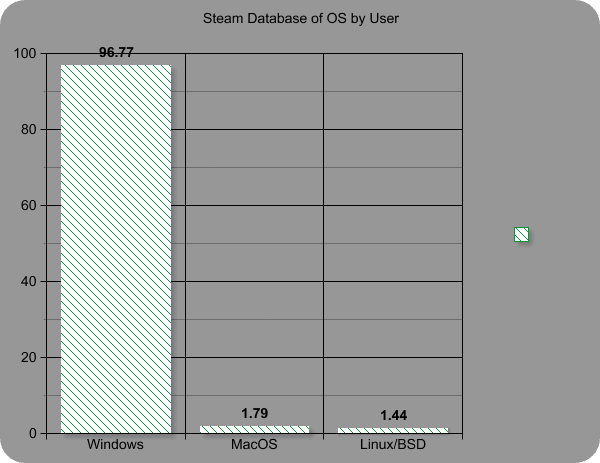
- June 2023 Results are in - and only 1.79% of the Steam userbase is on the MacOS platform.
- By contrast, Windows accounts for 96.77% of the Steam userbase, and Linux accounts for 1.44% (I would love to see what Linux was looking like before the Steam Deck release).
- That leaves MacOS users at about 2,148,000 monthly active users - if we're to believe the 120m estimate from 2020.
- Not a small number, but not a big one either.
- This is what I call WiiU territory - except unlike the WiiU - these Macs aren't going anywhere.
 120 Million Monthly Active Steam Users
MacOS Total Monthly Active Steam Users: 2,148,000
How many NATIVE MacOS games are there?
-
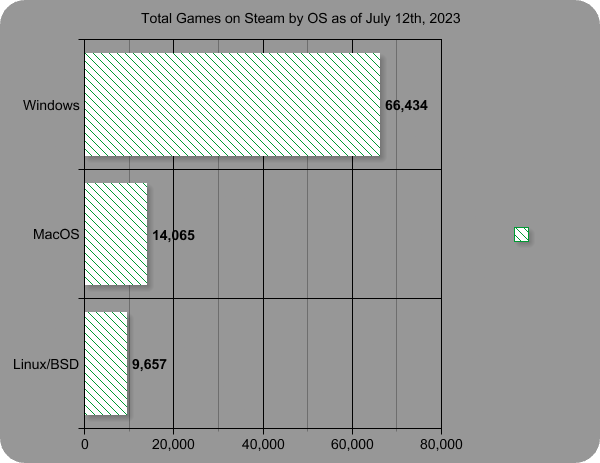
If you're to believe the Steam search/query page (As of July 12th 2023):
- Total: 83,074
- MacOS: 14,065 - Est. 16.9%
- Windows: 66,434 - Est. 80%
- Linux: 9,657 - Est. 11.6%
-
-
Granted, there could be games in here that are 32-bit on MacOS (which would render them useless for modern Macs without some work from the dev) - but a 16.9% footprint on Steam isn't nothing!
-
To name a few, here are some native MacOS games ready to be played, pictured below: !

Well, okay, so how do these users currently play? And is there anything new in the horizon?
Native Play on MacOS
Steam (Native)
- Steam offers a native client for MacOS that hosts all the games you could think of that have Native Apple support. Now, native apple support can mean a couple things given Apple's recent switch to its own silicon. Given the fact that up until now, Macs would use Intel CPUs, Apple needed to create a way for Apple Silicon computers to run Mac Apps meant for Intel CPUs. This is where Rosetta comes in. Simply put: "Rosetta 2 enables a Mac with Apple silicon to use apps built for a Mac with an Intel processor."
- Having tested out KOTOR 1 and 2, Divinity Original Sin 2, and Bioshock - I can say for certain that native Mac versions are viable. I haven't experienced any issues in my time playing native titles that would tell me otherwise.
Gaming through a VM (Parallels)
- Note: Parallels is a paid application - Parallels website
- Before the talks of GPTK (more below) the only other ways to game windows on Mac were through Wine (Crossover), Dual Booting into Windows (if you have an Intel Mac that is), OR, gaming through Parallels (a sophisticated Windows VM client made for Macs)
- Parallels already actually accomodates for this behavior, and they actively advertise the "Game Mode" through their direct channels
- I have had a surprisingly good, albeit short, experience playing Skyrim on Medium settings through Parallels.
- NOTE: MORE TO COME ON THIS AT A LATER DATE
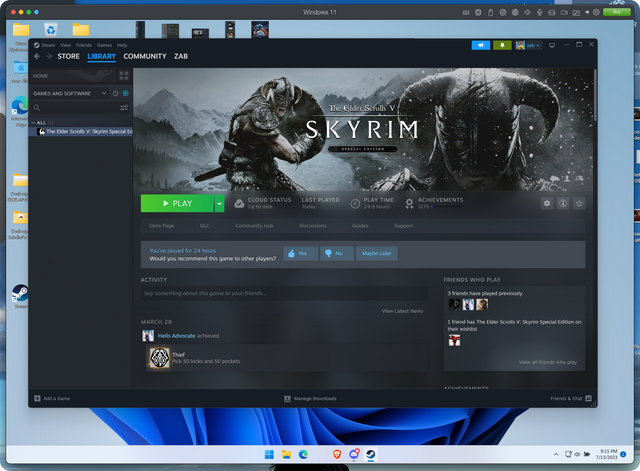
Gaming through Emulation

Note: I will not cover emulation for any consoles that are still being actively sold or in print - such as the Nintendo Switch. While the technology exists, it's not in my interest to cover them. In other words, go buy a Switch. It's a pretty good console.
Modern-ish Consoles
- Playstation 3 - RPCS3
- My initial test was with Metal Gear Solid 4. Little did I know, Metal Gear Solid 4 has THE MOST PPU MODULES OF ALL PS3 GMAES WHEN EMULATING.... It took upwards of 3 hours to get all PPU modules loaded... needless to say, all the modules loaded and the game launched. It never got to the main screen - this could be limitations on my machine, the macos version of RPCS3, or a configuration issue. I followed this by then testing the Ico/Shadow of the Colluses PS3 bundle, which worked for me with no issues.
- It seems PS3 emulation is always a hit or miss, regardless of platform - at the very least the support is there.
- ~~Xbox360 - no MacOS support from Xenia~~
- WiiU - Ceme Emiyl
- Untested - MORE TO COME ON THIS AT A LATER DATE
Retro Emulation
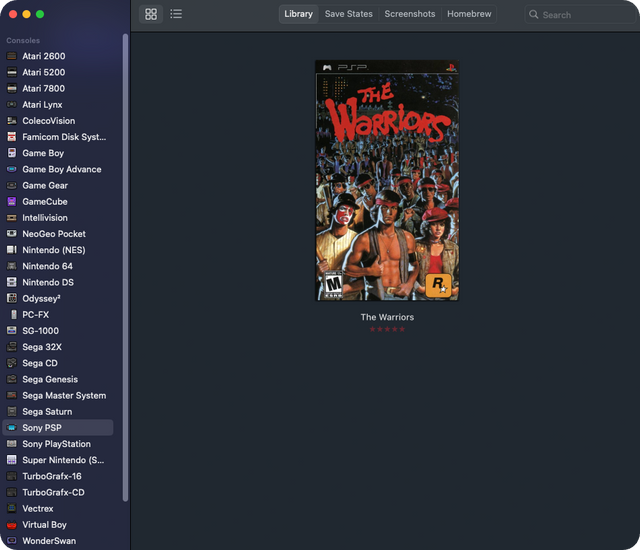
- OpenEmu supports Atari 5200, Intellivision, Super Nintendo, ColecoVision, NintendoDS, GameCube, Game Boy, Sega Genesis, Megadrive, Neo Geo Pocker, Game Boy Advanced, N64, Sony PSP, and some others listed in the image above. Needless to say, as a single download, it's got all the bases covered.
- This tool provides MacOS users an endless back catalog of titles to play through. Less sexy than, say, GPTK - but the option is there, and most importantly, highly reliable.
- Notably absent from OpenEmu: Dreamcast, Playstation 2, GameCube, Original Xbox. Thankfully, there are working solutions for each.
- GameCube: Dolphin
- Playstation 2: AetherSX2 - (Works great! But sickos from the internet have scared away the sole developer working on this emulator - last update was February of last year on https://www.aethersx2.com/archive/ - anyway, download this, it's awesome)
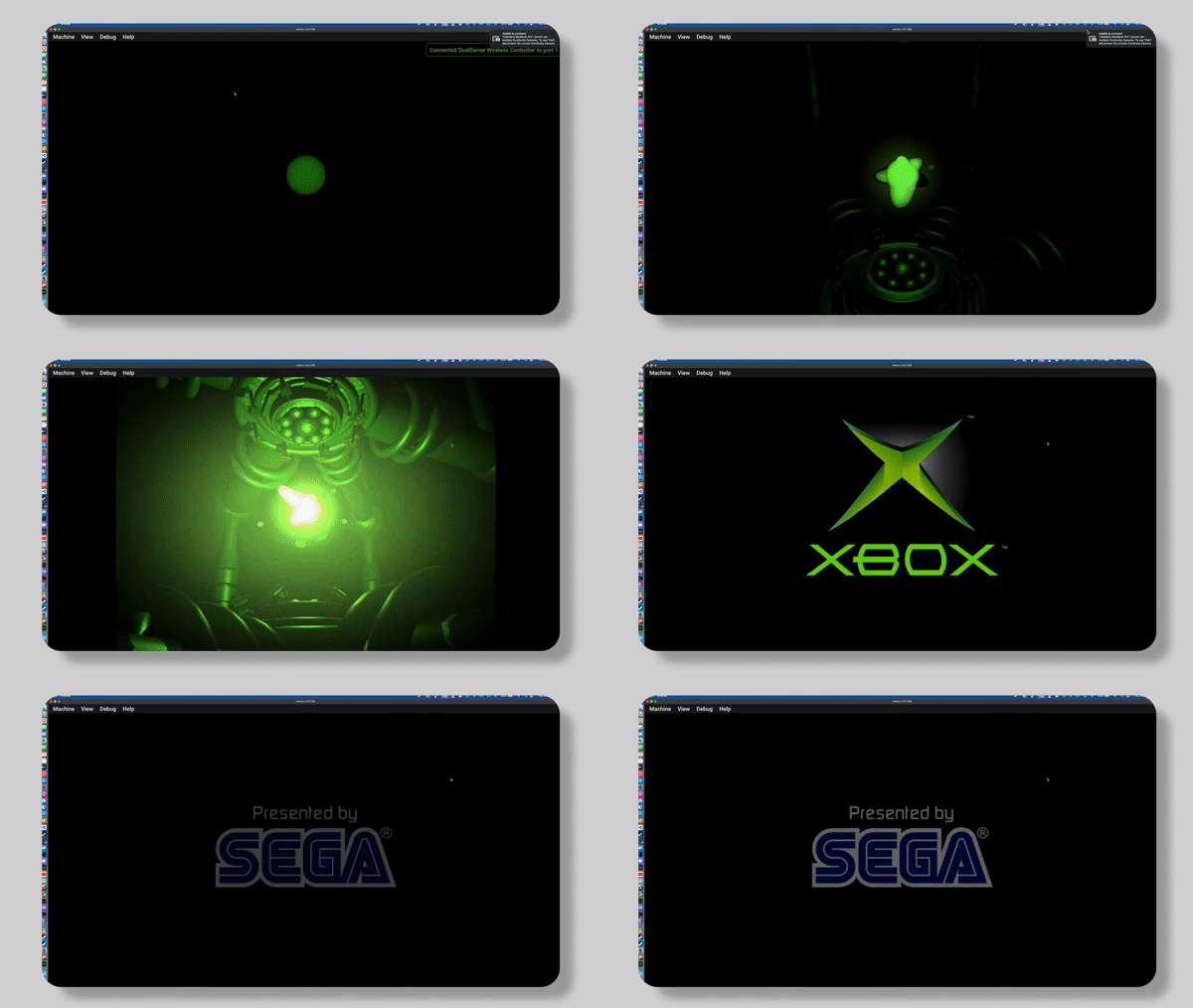
- Xbox Original: Xemu - this is simply one of the cleanest emulators I have seen in a LONG time.
MORE TO COME ON THIS IN THE FUTURE!- I just had to share the gif below.
- Dreamcast: Redream
MORE TO COME ON THIS IN THE FUTURE!
Cloud Gaming

Xbox Game Pass Ultimate
COMING SOON
Nvidia GeForce Now
COMING SOON
Amazon Luna
COMING SOON
Future Play and Development on MacOS (GPTK)
Let's address a quick difference here on Valve vs Apple in these tranlastion libraries)
- Do not confuse Valves
Protonlibrary with ApplesGame Porting Toolkit- trust me, they can be easily confused. Considering Valve's recent success, it's simply become an easy headline to write. To rid ourselves of any confusion:Valves Proton: "Proton is a new tool released by Valve Software that has been integrated with Steam Play to make playing Windows games on Linux as simple as hitting the Play button within Steam. Underneath the hood, Proton comprises other popular tools like Wine and DXVK among others that a gamer would otherwise have to install and maintain themselves. This greatly eases the burden for users to switch to Linux without having to learn the underlying systems or losing access to a large part of their library of games."Apple's Game Porting Toolkit: "Game Porting Toolkit is Apple's new translation layer released on 6th June, 2023. Game Porting Toolkit (GPTK) combines Wine with Apple's own D3DMetal which supports DirectX 11 and 12."- In laymens terms, where these Windows games would make API calls to Windows specific services like DXDirect, it translates these calls and directs them to Apples Metal API - so Proton uses Vulkan for its translation calls and GPTK uses Metal for its translation API calls. Not the same thing, but the same thing, know what I mean?
- Now, we briefly covered GPTK - and please note, this was released not too long ago (June 6th, 2023). In comparison to Proton, which released August 21st, 2018 ~ and you won't be surprised to hear that the compatibility list announced by Valve at the time was 27 games. But notice the difference here in approach here:
- Valve announces known running games on launch - continues open source work on this for years before putting the nose to the books prior to the Steam Deck release.
- Apple announces it as a package of updates to their Developer channel, explicitly does not call it an emulation technorlogy for consumers - instead states this is strictly for developers to see the amount of work a Windows native port would be with no extra effort. So obviously, Apple's interpretation is more closed off. Clearly their intention isn't to make this consumer grade.
- However, this has not stopped the community one bit. The consumer is using this tool as consumer grade regardless.
Community Tools leveraging GPTK
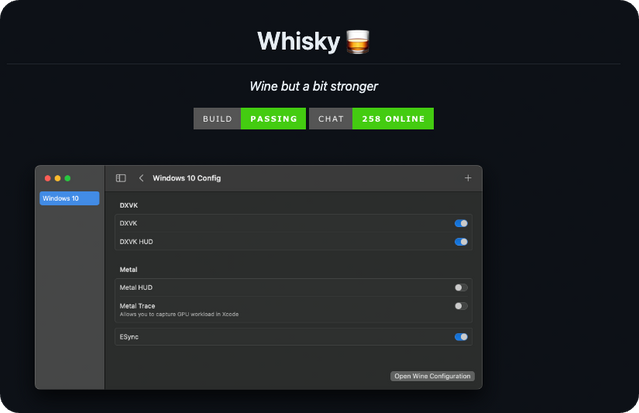
So we have Crossover, which leverages Wine + Rosetta to provide Windows emulation and support for Apple Silicon. We also have Whisky, a free open source application that is built on top of Crossover. In addition, you can also try to run applications right from terminal after installing GPTK via Apple's explicit instructions. Unfortunately, my experience with all three have been expectedly inconsistent.
There are plenty of much more prepared experts on the topic of Whisky, Crossover, and GPTK installation on YouTUbe alone, so I won't regurgitate that already great information. However, as a note, my experience is that the front-end for Crossover was laggy and inconsistent, where Whisky's use of Swift UI was clean and responsive by comparison. But my experience with GPTK and Windows emaulation in general was.. eye opening.. inconsistent... hope-inducing.
No matter what compatibility list I found online, my experience was wildly different from the postings you'd see on r/macgaming, on Whisky's discord, or even in Digital Foundry's recent video on this topic. Now it could be a matter of my SOC being an M1 Pro... regardless, here has been my experience with the titles below:
- Dead Space (2023) - launches and plays, stutters constantly, low fps (Given my SOC, makes sense... at least it launched!)
- Guilty Gear Strive - launches, but crashes once the fight is about to start
- Spider-Man Remastered - Launched and Played - Errors on the game needed Windows 10 build 1909 or later (on both Whisky and Crossover) - this was fixed in Whisky by manually changing the build number
- Resident Evil 3 - launches - crashed once the game loads past the New Game screen
- Skyrim - Launch and Plays - Would not initially launch - had to rename the .exe files to skip the initial launcher and go right to the game - unfortunately, the audio dialog is broken... but it runs great!
- Fallout New Vegas - would not launch - regardless of build number, launcher skips, etc.
The brief moments I got any of these to work at all... were eye opening. If you had told me a year ago that MacOS would be following suit and launching there own DirectX translation for games, well I just wouldn't have believed you. It wouldn't have run true to Apple's motivations at all. It's clear in the history: Mac has never truly cared about gaming - not in the traditional sense ~ I guess until now?
With that said, I do not recommend any user spin their wheels with this until it's, you know, maybe 2 years into the pipeline and the community pulls a Proton and just tests everything under the sun. The only reason I can't recommend holding your breath, however, is that Apple will never care about gaming as much as Valve does... so the future of GPTK as a technology is truly up in the air.
I don't want to disparage that the technology is an ultimate good ~ it's just new, you know? This will take time.
Contemporary PC Gaming Technology on the MacOS platform
Adaptive Sync (VRR)
- https://support.apple.com/en-us/HT212232
- A staple in PC Gaming - and now supported on MacOS
Controller Support
- https://support.apple.com/en-us/HT210414
- I have had no issues whatsoever connecting the
Sources
- https://support.apple.com/en-us/HT212232
- https://vesa.org/featured-articles/vesa-adds-adaptive-sync-to-popular-displayport-video-standard/
- https://en.wikipedia.org/wiki/Usage_share_of_operating_systems
- https://blog.gitnux.com/personal-computer-statistics/#:~:text=The%20approximate%20number%20of%20personal%20computers%20in%20use%20worldwide%20is%202%20billion
- https://www.statista.com/statistics/733277/number-stream-dau-mau/#:~:text=Steam's%20owner%20Valve%20reported%20that,digital%20gaming%20content%20platforms%20worldwide.
- https://www.quora.com/What-Nvidia-GPU-is-equivalent-to-Apple-s-M1-Pro
- https://www.protondb.com/
- https://developer.apple.com/forums/tags/game-porting-toolkit
- https://www.applegamingwiki.com/wiki/Game_Porting_Toolkit
- https://support.apple.com/en-us/HT211861
- https://rpcs3.net/download
- https://vimm.net/vault/15531